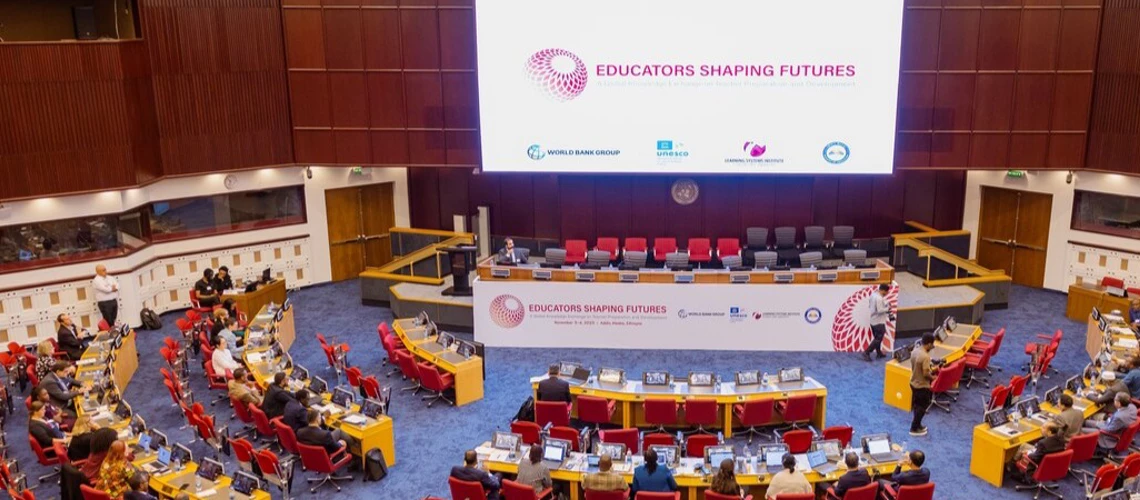
More than 340 participants from 41 countries—including policymakers, teacher educators, school leaders, researchers, and development partners—came together to grapple with a simple but urgent question: How do we prepare and support teachers so that every child learns?
The conversation focused on how to equip and enable teachers throughout their careers, through initial teacher education, induction in their first months in the classroom, continuous professional development, and leadership opportunities. Here are five things we know, five things we still need to learn more about, and five things we need to do to enable teachers to thrive and students to succeed.
Five things we know
- High-quality initial teacher education sets expectations and bridges theory and practice. Clear, competency-based standards; initial teacher education program content that is closely aligned with the curriculum; and high-quality, mentored school placements can produce graduates who are classroom-ready on day one of their teaching careers.
- Induction accelerates effectiveness of new teachers. Structured induction with trained mentors and protected time for observation, feedback, and reflection reduces attrition and builds confidence in the first few years.
- Continuous professional development improves teaching quality when it is practice-based and relevant. Subject-specific, classroom-focused continuous professional development that includes planning, rehearsal, enactment, and follow-up such as coaching leads to measurable shifts in instruction and learning.
- Leadership is the multiplier. School leaders make teacher learning possible by protecting time, organizing peer collaboration, and building a culture of continuous improvement.
- Professional recognition fuels motivation. Respect for teachers must translate into recognition, reinforcement, remuneration, and rewards to attract and retain talent.
Five things we still need to learn more about
While we know a lot, gaps remain in our knowledge of how to effectively equip and enable teachers. Here are five areas we need to understand better:
- Improving at scale. How to deliver high-quality initial teacher education, induction, and continuous professional development at scale within government systems, particularly where resources are low, without diluting quality.
- Implementation evidence. Which combinations of field placement design, mentoring models, and follow-up to training deliver the best value for money across contexts.
- Teacher agency and wellbeing. How to embed teacher voice in design and decision-making and protect teacher wellbeing in ways that improve practice and retention.
- Responsible use of technology and AI. What it takes in terms of infrastructure, training, and safeguards to make tech tools genuinely helpful for teachers and equitable for students.
- Balancing rigor and relevance. How to uphold standards while supporting instruction in local languages, multi-grade classrooms, and other real-world conditions.
Five things we need to do
The exchange moved quickly from ideas to commitments. The top five actions participants said they will take as a result of the knowledge exchange are:
- Strengthen collaboration and partnerships. Build or deepen ties with peers, the “middle tier” (district, regional, or subnational actors), government, and international educator networks to co-develop solutions and share practices.
- Advocate for change and policy reform. Champion teacher-led transformation and evidence-based approaches with policymakers; push for inclusive teacher training and better support for teachers.
- Improve and restructure teacher preparation and development. Update or redesign initial teacher education and continuous professional development by integrating new models, co-designing with teachers, and strengthening induction and mentoring.
- Share and disseminate knowledge internally. Brief colleagues and teams; circulate resources, evidence, and tools from the exchange to extend learning beyond direct participants.
- Apply specific concepts and tools. Pilot concrete ideas such as responsible use of AI for coaching; integrate new concepts into initial teacher education and CPD; and test practice-based approaches such as “Learning to Teach by Learning to Learn.”
When teachers are well prepared and continuously supported, more children have the opportunity to master foundational skills and stay in school longer. Those gains compound into healthier lives, higher earnings, and more resilient economies. Investing in effective teacher preparation and development is investing in a nation’s future.
This is why the World Bank’s education and skills strategy, focused on equipping learners with essential foundational skills for work and life, recognizes the central importance of teachers. Preparing and supporting teachers from initial education through induction and ongoing professional learning is essential to ensuring that every child masters foundational skills and builds the higher-order and digital competencies today’s economies demand.
Back in Addis Ababa, the student poet captured what data often cannot: the promise of a teacher who sees you, believes in you, and knows how to help you take the next step. That promise is why this agenda matters, and why we must keep teachers at the center, as co-creators of solutions. If we do, we won’t just improve classrooms; we’ll strengthen human capital, one prepared and supported teacher at a time.